Google Maps Gets Ask Maps and Immersive Navigation: What's New and Why It Matters

Google Maps Gets Ask Maps and Immersive Navigation: What's New and Why It Matters
Google has spent years adding more intelligence to Maps, but the update it announced on March 12, 2026 feels different. This time, the company is changing two habits people use every day: how they ask Maps where to go, and how Maps guides them once they are on the road.
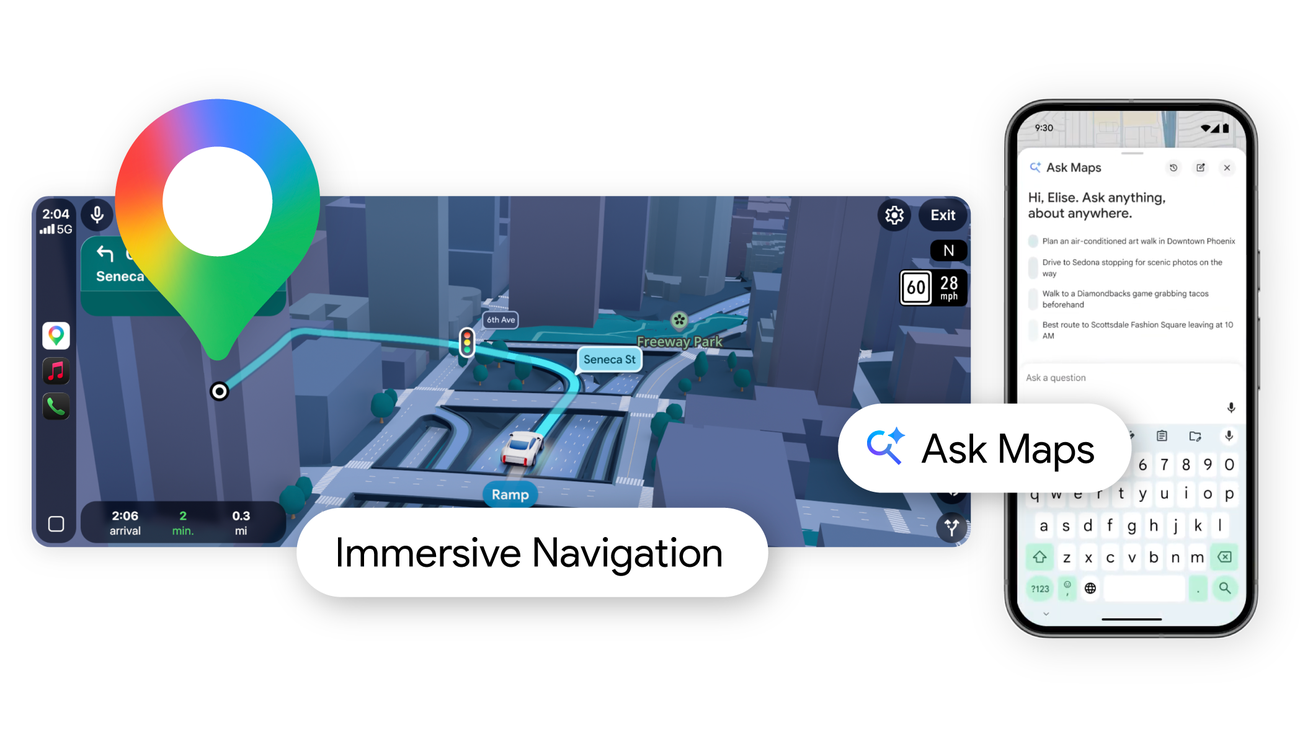
The official launch centers on two features: Ask Maps, a conversational way to ask complex real-world questions inside Google Maps, and Immersive Navigation, a major redesign of driving guidance with more visual context, more route awareness, and better last-mile help. You can read the launch post here: How we're reimagining Maps with Gemini.
This is the important part: Google is not just dropping a chatbot into Maps. It is trying to turn Maps into something more useful than search plus directions. If this works well, Maps stops feeling like a tool you query and starts feeling more like a system that understands what you are trying to do.
What Google actually launched
Google's framing is straightforward: it is combining Gemini with what it calls the world's freshest map. In practice, that means two new consumer features.
Ask Maps is a new conversational interface inside Maps. Instead of typing a short keyword search like "coffee" or "EV charging," you can ask more human questions with real constraints attached. Google's examples are very practical: where to charge your phone without waiting in a long coffee-shop line, or whether there is a public tennis court with lights available tonight. The answer comes back as a conversation, paired with a custom map that shows options visually.
Immersive Navigation is the other half of the launch. Google describes it as its biggest navigation upgrade in more than a decade. The feature adds a much richer route view, clearer guidance on road details, smarter zooms, more natural voice directions, and better help once you are actually close to the destination.
That matters because Maps has always had two separate jobs: help you discover places and help you get there. This launch upgrades both sides at once.
Ask Maps is the bigger shift than it looks
On the surface, Ask Maps can sound like "Google Maps, but with Gemini answers." That undersells it.
What Google is really doing here is moving local search from keyword lookup to intent understanding. That is a meaningful change. A normal map search is good when you already know the category you want. A conversational map is more useful when your real need is messy, specific, and contextual.
Think about the kinds of decisions people actually make:
- You need a dinner spot that works for four people coming from different parts of the city.
- You want a quiet cafe with outlets, not just a cafe.
- You are planning a day trip and want smart stops along the route, not a list of landmarks.
- You care about vegan options, parking, outdoor seating, or whether a place feels good for a date or a family visit.
That is where Ask Maps could be genuinely better than old-school search. Google says the feature uses information from more than 300 million places and insights from a community of more than 500 million contributors. It also personalizes results based on what you have searched for or saved in Maps. So the product is not just answering a question; it is grounding the answer in live place data, reviews, your own context, and an actual map you can act on immediately.
One simple example is parking. Finding a good restaurant was never the hard part. Finding a good restaurant with easy parking, a sensible entrance, and less hassle once you arrive was the part that usually forced you into a clumsy loop: search a category, open a few place cards, skim photos, read scattered reviews, then guess. Ask Maps looks like Google's first serious attempt to collapse that process into one step. If Gemini can reliably read the same reviews, place details, and map context you would otherwise dig through yourself, the product becomes useful in a much more concrete way than a generic chatbot recommendation.
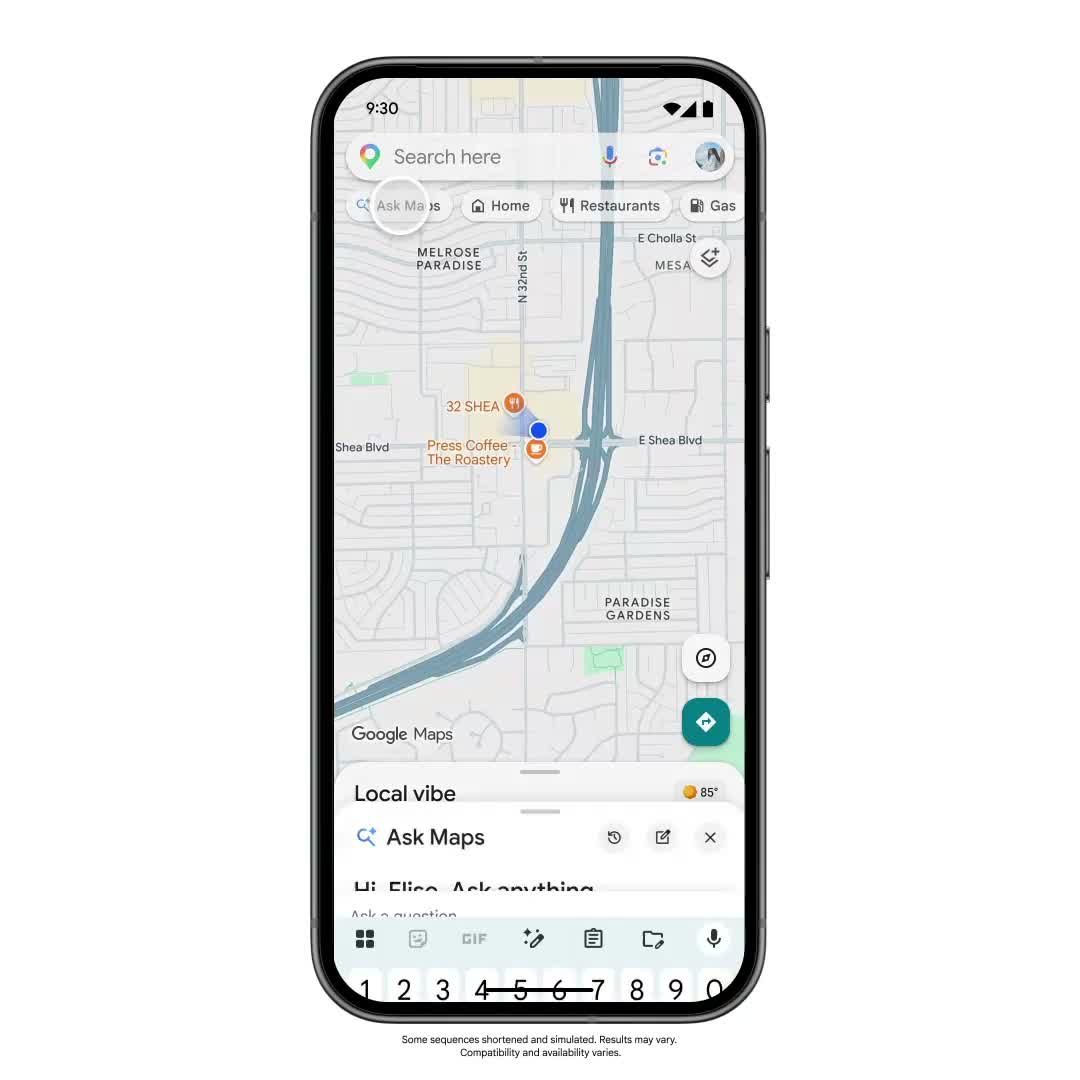
Official Google launch visual for Ask Maps trip planning.
This is the part I think matters most: Ask Maps closes the loop. Generic AI tools can suggest places. Maps can do something more useful. Once a place looks right, you can save it, share it, get directions, and in some cases book a reservation without leaving the flow. That makes the feature more than a novelty layer on top of local search.
Google also uses a good example in the launch post: if your friends are coming from Midtown East and you want a cozy place for four at 7 p.m., Ask Maps can factor in convenience, atmosphere, timing, and your known preferences. That is much closer to how people naturally ask for recommendations.
If Ask Maps works well in the real world, the biggest change will be behavioral. People may stop "searching Maps" and start asking Maps.
Immersive Navigation looks like the practical win
Ask Maps is the flashy part of the announcement. Immersive Navigation may end up being the feature people appreciate more day to day.
Google says the new navigation experience uses Gemini together with fresh imagery from Street View and aerial photos to build a more accurate, spatial understanding of your route. On screen, that means a 3D-style route view that reflects buildings, terrain, medians, overpasses, and other landmarks around you. When it helps, Maps highlights details like lanes, crosswalks, traffic lights, and stop signs, so the next turn or merge is less of a last-second surprise.
Google is also updating the pacing of navigation itself. The map now gives you a broader look ahead, smart zooms help you see the next tricky segment sooner, and transparent buildings make it easier to see what is coming up. Voice guidance is becoming more natural too, more like spoken directions from a competent passenger than a clipped GPS command.
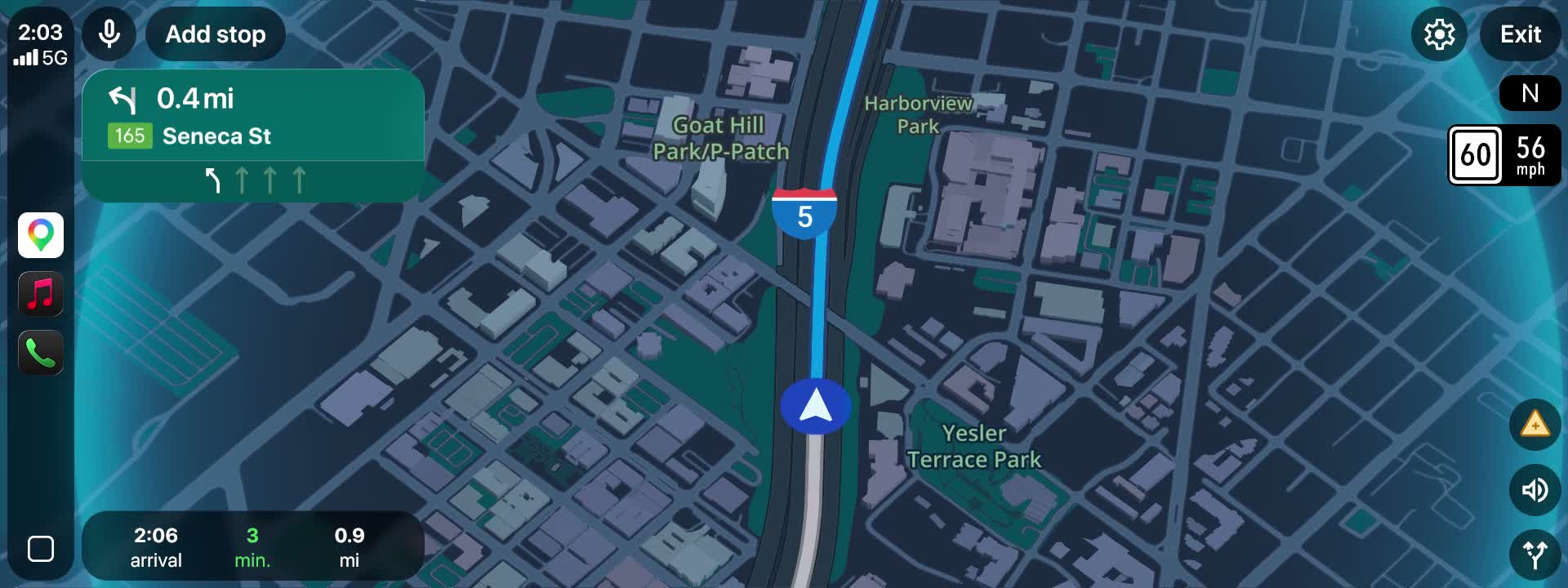
Immersive Navigation adds a much richer route view and clearer turn-by-turn context.
The part that feels most useful is not just the visuals. Google is also adding better tradeoff awareness for alternate routes. If one route is longer but avoids traffic, or another is faster but includes a toll, Maps can surface that more clearly. The company says Maps processes over 5 million traffic updates every second and receives more than 10 million driver contributions every day about disruptions like crashes and road construction. That gives it a strong base for explaining why one route is better than another.
Then there is the last-mile problem, which is where navigation still breaks down more often than people admit. Getting to the block is easy. Finding the right building entrance, the right parking area, or the correct side of the street is where stress shows up. Google is now explicitly addressing that. Before you leave, you can preview the destination and surroundings with Street View imagery. As you arrive, Maps can highlight the entrance, nearby parking, and where you should actually end up on the street.
If Ask Maps is about reducing planning friction, Immersive Navigation is about reducing arrival friction.
The real new capabilities this unlocks
The easiest way to understand this update is to look at what became possible overnight.
Constraint-heavy local search becomes normal. Maps can now handle questions that combine distance, timing, preferences, and intent in one shot. That is a better fit for how people make real decisions.
Trip planning moves closer to one interface. Google uses an Arizona road trip example in the launch materials, but the bigger point is that Maps is becoming better at chaining discovery, route planning, saved stops, and navigation into one flow.
Personalization becomes more useful, not just more decorative. Knowing that you prefer vegan restaurants or have saved certain places is not interesting by itself. It becomes interesting when the system uses that information to narrow choices intelligently.
Driving gets more spatial. Traditional navigation gives you instructions. Immersive Navigation tries to give you understanding. That sounds subtle, but it matters in unfamiliar cities, complicated interchanges, and awkward final approaches.
Maps starts looking more agent-like. I do not mean a fully autonomous travel agent. I mean the product now has a stronger ability to interpret what you mean, pull together the right data, and move you into action without forcing you to rebuild context across five separate apps.
That last point is probably the biggest strategic shift. The feature set is still narrow and grounded, which is good. But the direction is obvious: Google wants Maps to feel less like a directory and more like a live decision layer for the physical world.
Why this puts pressure on Apple Maps
This launch also makes the competitive gap easier to see.
Apple Maps is not standing still. Apple has been adding more intelligence to the product, including Preferred Routes and Visited Places, and Apple says AI and machine learning are central to making its services feel more personal and intuitive. Apple also has system-level AI through Apple Intelligence, and officially integrates ChatGPT into Siri and other Apple Intelligence experiences. You can see those directions in Apple's own announcements: Apple services updates for Maps, Apple Intelligence, and Apple's ChatGPT support page.
But there is a real difference in approach right now. Google's update is centered on conversational local discovery plus AI-assisted navigation inside the map itself. Apple's public messaging is still more focused on privacy, on-device intelligence, Siri, and incremental Maps improvements rather than a full Ask Maps-style layer.
That is why I think Apple Maps risks looking behind if Google executes this well. Not because Apple Maps is bad, but because the product categories are starting to shift. Once users get used to asking for "a kid-friendly dinner spot with easy parking between these two neighborhoods" or "a quiet coffee shop with outlets where I can stay for two hours," regular map search starts to feel old very quickly.
The next question is the obvious one: will Apple eventually bring a model like Gemini into Apple Maps or CarPlay? As of March 13, 2026, Apple has officially talked about ChatGPT inside Apple Intelligence and continues to describe CarPlay as using Siri voice control together with Apple Maps. I am not seeing an official Apple announcement that puts Gemini inside Apple Maps or CarPlay. So for now, the honest answer is: maybe later, but nothing official yet. That is an inference from Apple's published product announcements, not a confirmed roadmap.
If Apple does respond, it probably will not copy Google exactly. Apple has been consistent about privacy, on-device processing, and tight system integration. So any stronger AI layer in Maps or CarPlay would likely follow that design philosophy rather than look like a straight Gemini wrapper. But until Apple shows that product, Google has a chance to define the category first.
What this means for local discovery and businesses
Google Maps already reaches more than 2 billion users each month according to Google's own public numbers. So any change to how people discover places inside Maps matters well beyond product design.
If conversational discovery grows, then local businesses will need to think less about a single keyword and more about whether their listing is actually understandable to both humans and machines.
That means the basics matter even more:
- accurate hours and categories
- clear business descriptions
- booking links and menu information
- parking and accessibility details
- EV charging information where relevant
- fresh photos
- useful, real reviews that describe the actual experience
I would not overstate this and pretend Google has published a brand-new local ranking formula. It has not. But the product direction is clear. If people start asking questions like "quiet brunch place with outdoor seating that is easy to park near" or "kid-friendly dinner spot between these two neighborhoods," then complete listings and descriptive reviews become more valuable inputs.
This is also where Google's scale matters. The company has been investing for years in review quality, contributed content quality, and map freshness. That groundwork is what makes a feature like Ask Maps plausible. Without trusted data, a conversational map quickly becomes a confident liar.
For users, the upside is obvious: less scrolling, less filter fiddling, and fewer jumps between search results, social posts, reviews, reservation apps, and navigation. For businesses, the message is simpler: stale listings and thin profiles will age badly in a conversational discovery world.
Rollout, timing, and what to watch next
Google says Ask Maps starts rolling out now in the U.S. and India on Android and iOS, with desktop coming soon. Immersive Navigation starts rolling out across the U.S. now, then expands over the coming months to eligible iOS and Android devices, CarPlay, Android Auto, and cars with Google built-in.
This launch also fits a broader pattern. Back in late 2024, Google started bringing Gemini into Maps for inspiration and richer place understanding in the U.S. In January 2026, it extended Gemini in navigation to walking and cycling worldwide wherever Gemini is available. The March 12 update feels like the next logical step: not just an assistant layered onto Maps, but Maps itself becoming more conversational and more spatially aware. If you want the earlier context, Google's 2024 update is here: New in Maps: Inspiration curated with Gemini, enhanced navigation and more, and the walking/cycling expansion is here: Gemini in navigation is now available for walking and cycling in Google Maps.
There are still open questions. The first is simple: how good are the answers really once people throw noisy, subjective, or edge-case questions at the system? The second is whether sponsored or commercial placements stay clearly separated if conversational discovery becomes a major traffic source. And the third is how quickly Google can expand coverage beyond the initial markets without degrading quality.
Still, the direction is hard to miss. Maps has always been one of Google's most practical products. This update pushes it closer to something more ambitious: a tool that understands what you are trying to do in the physical world, then helps you move from question to action with less friction.
That is why this launch matters. Not because Maps has a chatbot now, but because Google is trying to make the map itself smarter.